
Total : ₹0.00

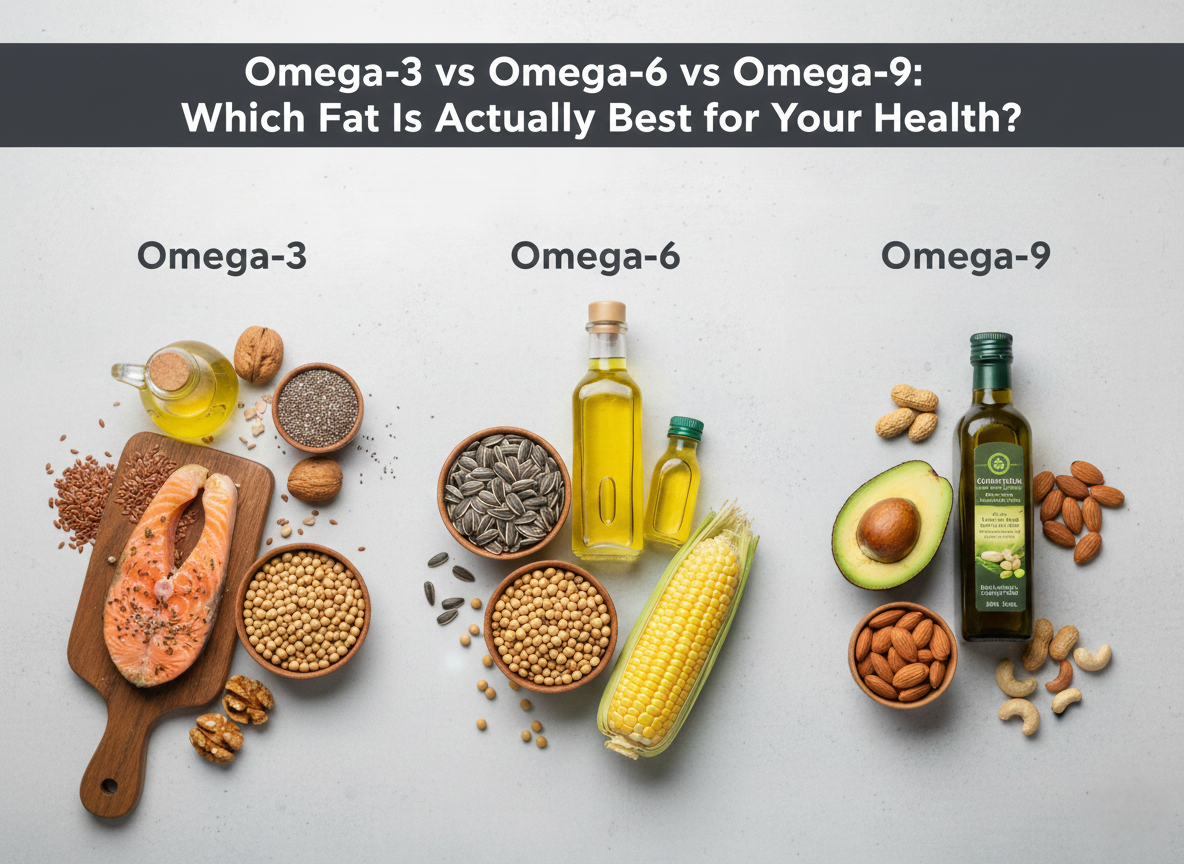
Omega-3 vs Omega-6 vs Omega-9: Which Fat Is Actually Best for Your Health?
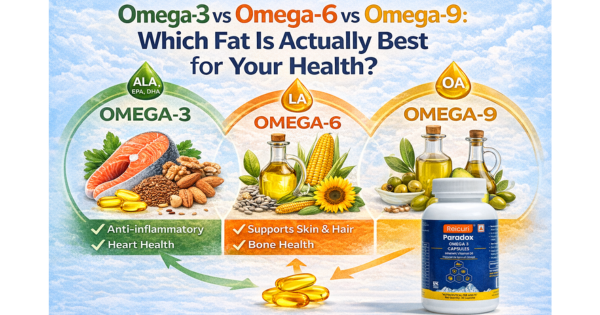
If you’ve ever looked at nutrition labels or health articles, you’ve probably seen Omega-3, Omega-6, and Omega-9 mentioned everywhere. But a common question remains: Which of these is actually good for us—and why?
Understanding the Three Omegas
Omega-3 and Omega-6 are called essential fatty acids, which means our body cannot make them on its own—we must get them from food.
Omega-9, on the other hand, is non-essential because the body can produce it naturally.
Where Are These Omegas Found?
- Omega-3
Found in fatty fish (salmon, sardines), fish oil, flaxseeds, chia seeds, and walnuts. - Omega-6
Found in vegetable oils such as sunflower oil, soybean oil, corn oil, as well as nuts and seeds.
- Omega-9
Found in olive oil, avocados, almonds, peanuts, and cashews.
So… Which Omega Is the Most Important?
- While all three play a role in overall health, Omega-3 stands out as the most important, especially in today’s lifestyle.
Why ?
Most modern diets already contain plenty of Omega-6 and Omega-9, mainly from cooking oils and processed foods. However, Omega-3 intake is often very low, creating an imbalance.
Bridging the Gap with the Right Omega-3
Because getting enough Omega-3 from food alone can be difficult, many families choose a supplement. A high-quality option like Reicuri Paradox Omega 3 is designed to help meet daily Omega-3 needs in a convenient and easy-to-consume format.
It focuses on providing essential Omega-3 support while fitting seamlessly into a balanced diet.
Final Thoughts
- Omega-6 and Omega-9 are already common in most diets
- Omega-3 is often lacking, yet plays a critical role in overall wellness
- The key is not choosing one Omega, but maintaining the right balance, with special attention to Omega-3
Making Omega-3 a regular part of your routine can be a simple yet meaningful step toward better everyday health.
FAQ
1. What are Omega fatty acids?
Omega fatty acids are healthy fats that play an important role in overall health. They are classified as Omega-3, Omega-6, and Omega-9 based on their chemical structure and functions in the body
2 . Which Omegas are essential?
- Omega-3 – Essential (must be obtained from food or supplements)
- Omega-6 – Essential (must be obtained from food)
- Omega-9 – Non-essential (the body can produce it)
3 . What is Omega-3 and why is it important?
Omega-3 fatty acids support:
- Brain and cognitive function
- Heart health
- Eye and vision health
- Joint flexibility
- Immune system balance
Main types of Omega-3:
- DHA (Docosahexaenoic Acid)
- EPA (Eicosapentaenoic Acid)
- ALA (Alpha-Linolenic Acid)
Sources: Fatty fish, fish oil, flaxseed, chia seeds, walnuts.
4 . What is Omega-6 and what does it do?
Omega-6 fatty acids help support:
- Normal growth and development
- Skin and hair health
- Energy production
Common source: Linoleic acid (LA)
Sources: Vegetable oils (sunflower, soybean, corn oil), nuts, seeds.
Omega-6 is beneficial but is often overconsumed in modern diets.
5 . What is Omega-9?
Omega-9 fatty acids support:
- Heart health
- Healthy cholesterol levels
- Anti-inflammatory balance
Common type: Oleic acid
Sources: Olive oil, avocados, almonds, peanuts.
Omega-9 is not essential, as the body can make it when Omega-3 and Omega-6 levels are sufficient.
6 . What is the key difference between Omega-3, 6, and 9?
| Omega Type | Essential? | Key Role | Common Sources |
| Omega-3 | Yes | Brain, heart, eyes | Fish oil, flaxseed |
| Omega-6 | Yes | Growth, skin | Vegetable oils |
| Omega-9 | No | Heart support | Olive oil |
7 . Why is balance between Omega-3 and Omega-6 important?
A healthy balance helps maintain:
- Normal inflammatory response
- Heart and metabolic health
Modern diets often contain too much Omega-6 and too little Omega-3, which can affect overall wellness.
8 . What is the ideal Omega-3 to Omega-6 ratio?
Experts generally suggest a ratio close to 1:4 (Omega-3 : Omega-6).
However, many modern diets reach ratios as high as 1:15 or more, making Omega-3 intake especially important.
9 . Can Omega-9 replace Omega-3?
No. Omega-9 cannot replace Omega-3 or Omega-6, as it is not essential and does not perform the same biological functions.
10 . Should children take Omega-3?
Omega-3, especially DHA, supports:
- Brain development
- Learning and focus
- Overall growth
Liquid Omega-3 formats are often easier for children to consume.
11 . Can I get all Omegas from food alone?
It is possible, but challenging—especially for Omega-3. Many people choose supplements to help meet daily Omega-3 needs while balancing Omega-6 intake from diet.
Final Thoughts
- Omega-6 and Omega-9 are already common in most diets
- Omega-3 is often lacking, yet plays a critical role in overall wellness
The key is not choosing one Omega, but maintaining the right balance, with special attention to Omega-3
Making Omega-3 a regular part of your routine can be a simple yet meaningful step toward better everyday health.